Aphasia & Cognitive-Communication Therapy
Evidence-based language rehabilitation following Stroke and Traumatic Brain Injury — restoring functional communication, reading, writing, and cognitive skills for patients across Rawalpindi, Askari, DHA, and Islamabad.
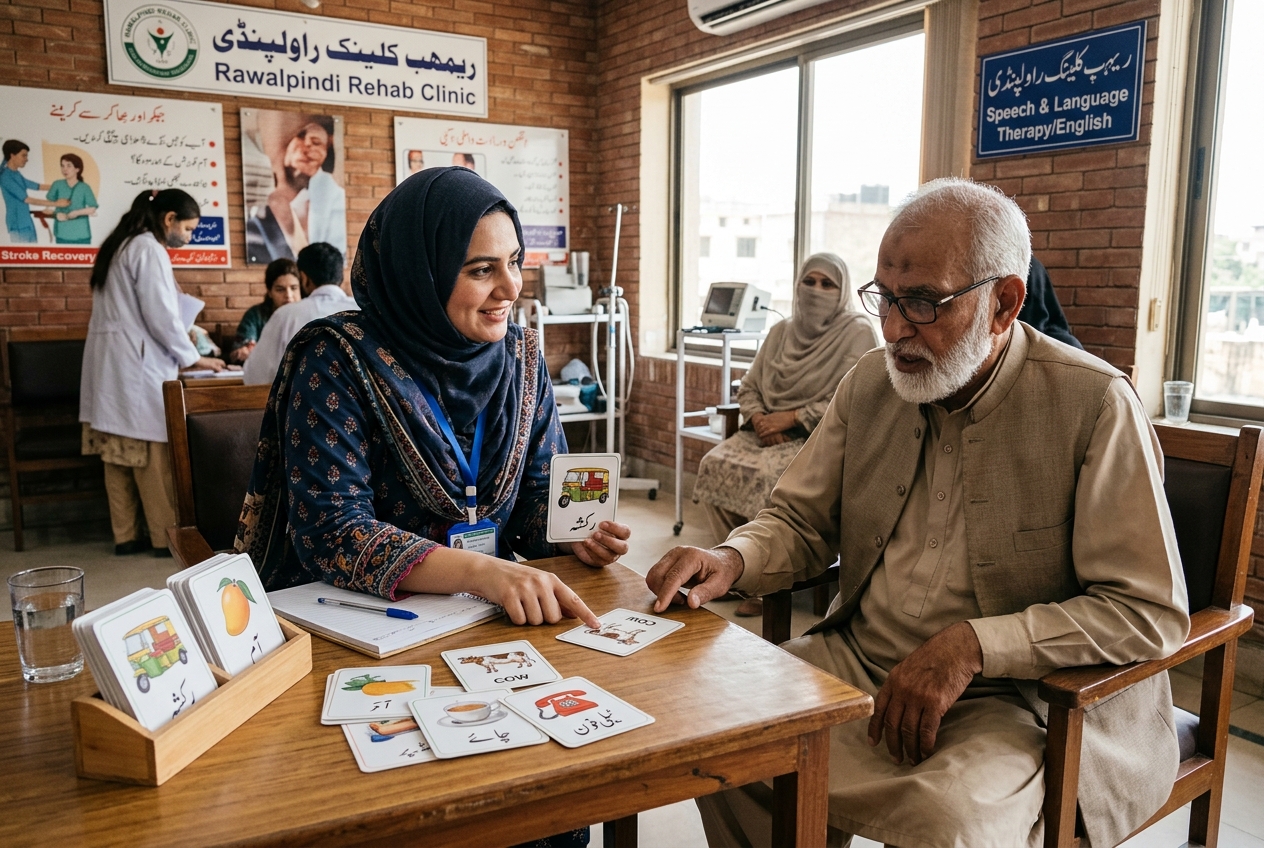
Understanding Different Types of Aphasia
Broca's Aphasia
Non-fluent aphasia with effortful, telegraphic speech but relatively intact comprehension. The person understands language but struggles to produce it. Most common after left frontal lobe stroke.
Wernicke's Aphasia
Fluent but paraphasic speech — the person speaks easily but uses wrong words or neologisms. Comprehension is significantly impaired. Occurs after left temporal lobe damage.
Global Aphasia
Severe impairment of both expression and comprehension. Typically follows large left hemisphere strokes. Intensive rehabilitation and AAC strategies can significantly improve functional communication.
Cognitive-Communication Disorder
Follows Traumatic Brain Injury (TBI) — affects attention, memory, organisation, and social communication without necessarily affecting core language skills.
Signs of Aphasia or Cognitive-Communication Difficulty
- Difficulty finding words (anomia) — knowing the concept but not the word
- Speaking in short, effortful phrases rather than full sentences
- Using wrong words or made-up words in conversation
- Difficulty understanding spoken or written language
- Inability to read or write as before the stroke or injury
- Difficulty with numbers, calculations, or reading a clock
- Personality or behaviour changes affecting communication (after TBI)
How We Rehabilitate Communication
- Comprehensive aphasia assessment (Western Aphasia Battery — Revised, BDAE-3)
- Constraint-Induced Language Therapy (CILT) for maximising verbal output
- Semantic feature analysis for word retrieval
- Script training for highly used communicative contexts
- Reading and writing rehabilitation
- Supported conversation training for family members
- AAC strategies for severe aphasia (communication books, apps)
- Group aphasia therapy for social communication and confidence
Common Questions About Aphasia Recovery
How soon after a stroke should therapy begin?
The sooner, the better. Evidence strongly supports beginning speech-language therapy within the first days or weeks after stroke. The brain's neuroplasticity is highest in the acute and subacute phase (0–6 months), making early, intensive intervention critical for language recovery.
Can aphasia be cured?
Aphasia cannot always be 'cured', but significant functional improvement is achievable for most people with structured rehabilitation. Many individuals with aphasia continue to improve for months and even years after onset, especially with ongoing therapy and self-practice.
My family member had a stroke 2 years ago — is it too late for therapy?
No. While early therapy yields the fastest gains, neuroplasticity continues throughout life. Chronic aphasia (more than 6 months post-onset) also responds to intensive, targeted therapy. We assess each patient individually and set realistic, functional goals.
Do you visit patients at home or at hospitals?
Our primary service is clinic-based at our Adyala Road centre. For initial consultations or patients with mobility difficulties, we may be able to arrange appropriate referrals. Please call us to discuss your specific situation.
Reclaim Your Voice After Stroke
Convenient access from Askari, DHA, Bahria Town, Gulshan Abad, Khawaja Corporation, and central Rawalpindi & Islamabad.