Motor Speech Therapy
(Dysarthria & Apraxia)
Improving speech intelligibility, articulation precision, and motor planning after neurological injury — evidence-based motor speech rehabilitation for patients across Rawalpindi, Askari, DHA, and Islamabad.
Types of Motor Speech Disorders
Dysarthria
Weakness, paralysis, or incoordination of the speech muscles caused by neurological damage. Results in slurred, slow, or imprecise speech. Severity ranges from mild to unintelligible. Occurs after stroke, TBI, Parkinson's, MS, and other neurological conditions.
Apraxia of Speech (AOS)
A motor planning and programming disorder — the person knows what they want to say but the brain cannot send the right signals to the speech muscles. Characterised by inconsistent errors and sound sequencing difficulties, worsening with increased word length.
Mixed Dysarthria
Multiple motor systems are affected simultaneously — common in conditions like ALS and Multiple Sclerosis — requiring a comprehensive approach targeting rate, resonance, respiration, phonation, and articulation simultaneously.
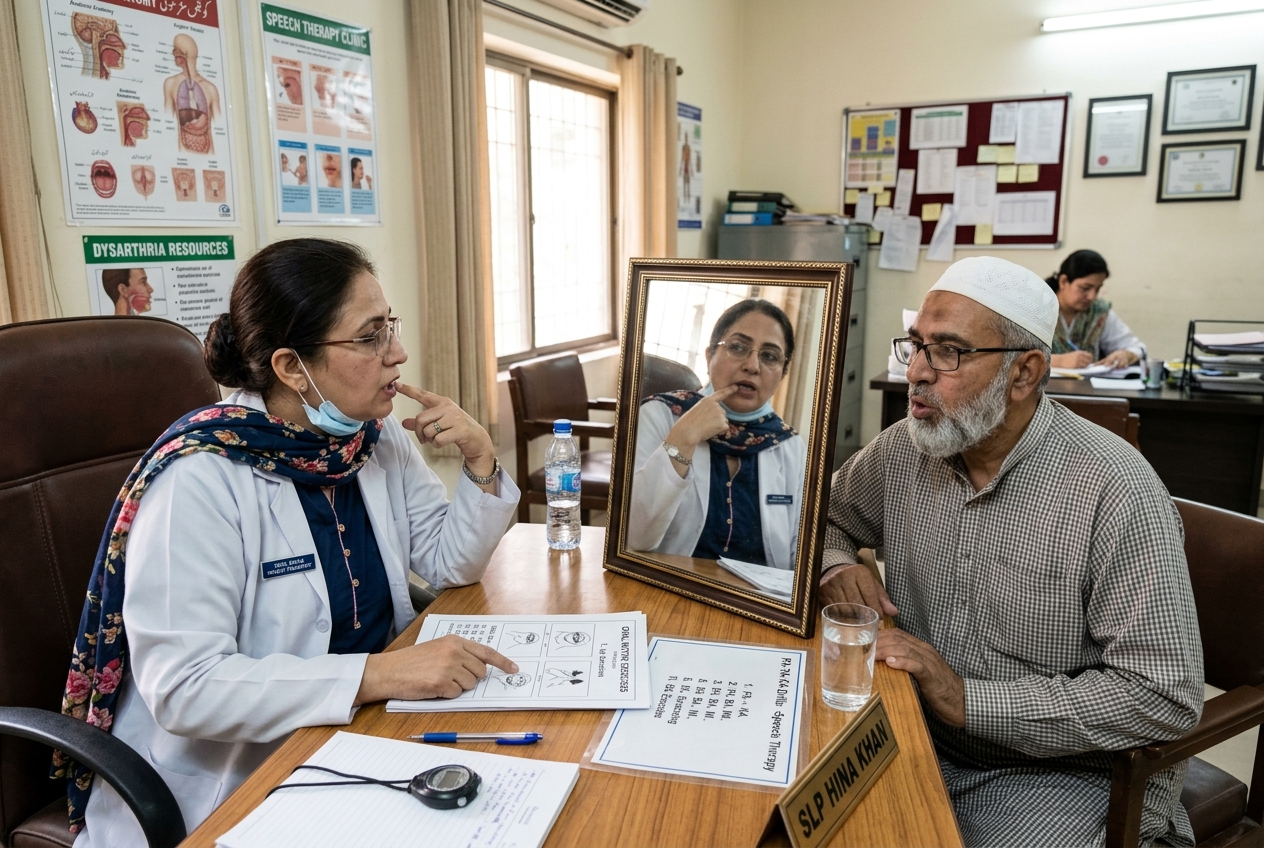
How We Rehabilitate Motor Speech
- Comprehensive motor speech assessment (Frenchay Dysarthria Assessment, DIVA model for AOS)
- Intensive rate, rhythm, and clarity drills using motor learning principles
- Lee Silverman Voice Treatment (LSVT LOUD) for Parkinson's disease
- Biofeedback-assisted therapy for dysarthria intelligibility
- Apraxia of Speech treatment: Sound Production Treatment (SPT), Motor-Kinematic treatment
- Prosody and stress pattern training
- Respiratory support for speech (breath patterning, speaking valves)
- AAC assessment and implementation for severe motor speech disorders
Common Questions
What is the difference between dysarthria and aphasia?
Aphasia affects language — the ability to understand and use words and grammar. Dysarthria affects speech — the physical production of sounds. A person with dysarthria may have perfectly intact language but slurred or unclear articulation. Many stroke survivors have both.
Can dysarthria improve after stroke?
Yes, significantly. With intensive, targeted motor speech therapy, many patients recover meaningful levels of intelligibility, especially when therapy begins early. Even patients with chronic dysarthria (years post-onset) show improvement with structured intervention.
What is LSVT LOUD and do you offer it?
LSVT LOUD (Lee Silverman Voice Treatment) is an intensive, evidence-based protocol specifically designed for Parkinson's disease. It targets vocal loudness and has been shown to generalise to improved speech clarity and quality. We offer LSVT LOUD at our Rawalpindi clinic.
My family member's speech has become very slurred — what should we do?
Sudden onset of slurred or unclear speech can be a medical emergency (stroke). If the onset is sudden, call emergency services immediately. If the slurring has developed gradually (e.g., in Parkinson's or MS), contact us for a scheduled assessment.
Regain the Power to Speak Clearly
Serving Askari, DHA, Bahria Town, Khawaja Corporation, and Rawalpindi & Islamabad.