
Fluency Shaping
(Stuttering & Cluttering)
Evidence-based techniques to develop smoother, more confident speech in children and teenagers who stutter or clutter — serving Rawalpindi, Askari, DHA, Adyala Road, and Islamabad.
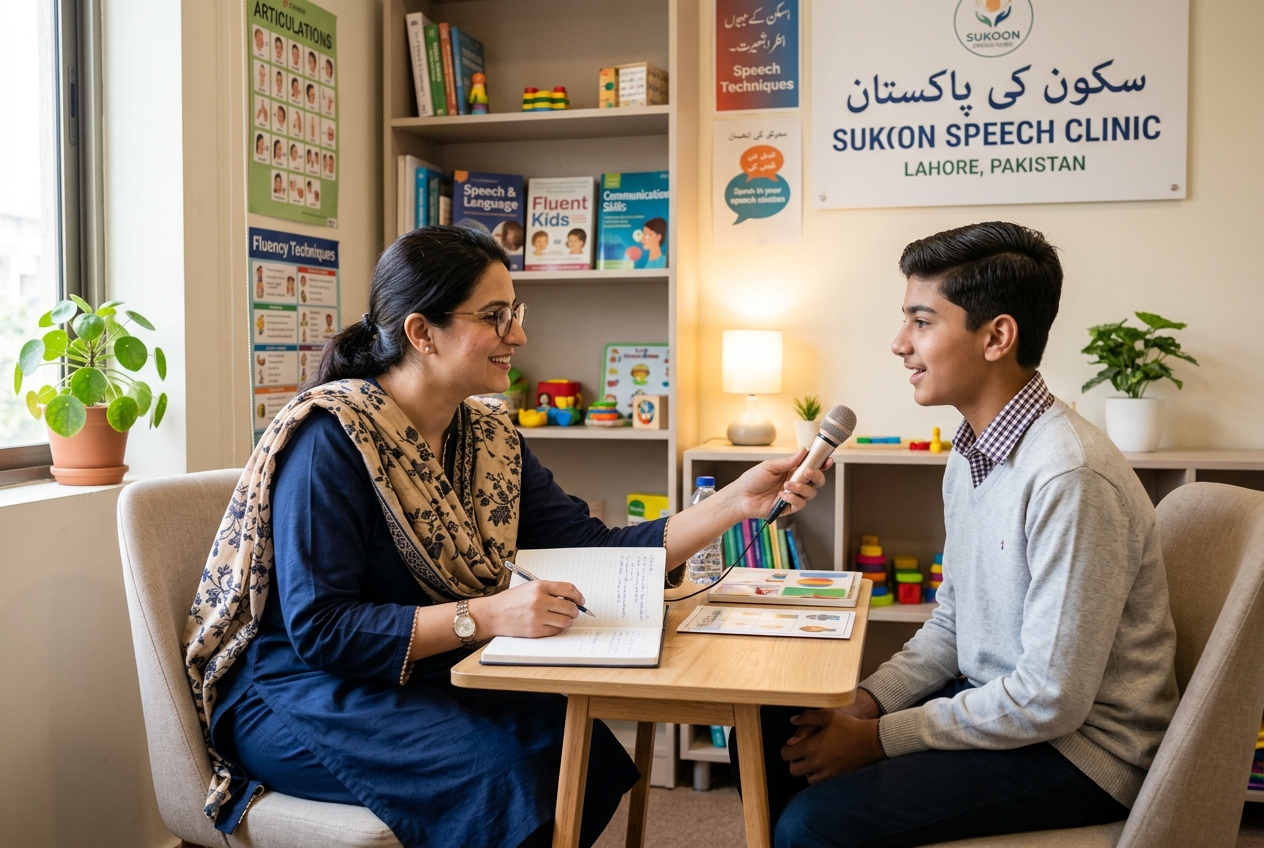
What Kind of Fluency Problem Does Your Child Have?
Stuttering (Stammering)
Stuttering involves involuntary repetitions, prolongations, or blocks in speech. It typically begins between ages 2–5 and affects approximately 5% of children, with 75% recovering naturally. Those who persist beyond age 5 benefit greatly from structured therapy.
Cluttering
Cluttering is characterised by an excessively fast or irregular rate of speech, telescoping of syllables, and reduced clarity. It often co-occurs with stuttering and requires distinct therapeutic approaches.
Neurogenic Stuttering
This type of stuttering develops after a neurological event (e.g., head injury, stroke). It requires different assessment protocols and is treated at our clinic as part of our adult rehabilitation services.
Signs to Watch For
- Repetitions of sounds, syllables, or whole words ('b-b-ball', 'I-I-I want')
- Prolongations — stretching sounds ('ssssun' for 'sun')
- Blocks — mouth open but no sound coming out
- Physical tension: eye blinking, lip trembling, or fist clenching when speaking
- Avoidance of speaking situations (school presentations, phone calls, social events)
- Sudden onset of stuttering in a child who previously spoke fluently
How We Treat Fluency Disorders
Fluency Shaping Therapy
Teaches new speech patterns using slow rate, easy onset, and continuous voicing to reduce stuttering events and build automaticity.
Stuttering Modification Therapy
Helps the child accept and modify moments of stuttering rather than avoiding them — reducing struggle and building confidence.
Lidcombe Programme
A parent-delivered, evidence-based programme for pre-school children that produces high rates of recovery when implemented consistently.
Integrated Approach (Teens)
Combines fluency shaping, cognitive restructuring, and desensitisation to address both the speech and the psychological impact of stuttering in older children and teenagers.
Common Questions About Stuttering Therapy
Will my child's stutter go away on its own?
Approximately 75% of children who stutter will recover naturally before adolescence. However, if stuttering persists beyond age 5 or causes distress, professional assessment is recommended. Early intervention significantly improves outcomes for those who will not recover naturally.
Should I finish my child's sentences to help them?
No — research shows that completing sentences increases pressure and can worsen stuttering. Instead, maintain natural eye contact, give your child plenty of time, and don't comment on the stutter. Our therapists provide full parent coaching.
Do you offer therapy for teenagers who stutter?
Yes. We have a specific teen fluency programme that addresses both the speech component and the psychological impact of stuttering, including social anxiety and avoidance behaviours common in adolescents.
How accessible is your clinic from DHA and Bahria Town?
Our clinic on Defence Road, Adyala is well-connected to DHA Phase 1–5, Bahria Town, Askari 14, Gulshan Abad, and the Adyala Road corridor. Most patients from these areas reach us within 10–15 minutes.
Help Your Child Speak with Confidence
Serving Askari 1–14, DHA, Bahria Town, Gulshan Abad, Khawaja Corporation, and all of central Rawalpindi & Islamabad. Early intervention leads to better outcomes.